What is Abstract Art?
Artist Wassily Kandinsky said, “Of all the arts, abstract painting is the most difficult. It demands that you know how to draw well, that you have a heightened sensitivity for composition and for colors, and that you be a true poet. This last is essential.”
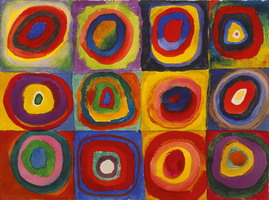
To understand Kandinsky’s quote, let’s look at the history of Western Art.
During the Renaissance period (1400-1525) artwork was characterized by realism, attention to detail, and precise study of human anatomy. Michael Angelo and Leonardo were pioneers in using linear perspective, and they created depth through intense lighting and shading.
The renaissance period saw the birth of Impressionism (1865-1885). Monet and Renoir sought to capture the immediate impression of a particular moment. These artists preferred painting outdoors. With visible brush strokes, they showed the changing qualities of light and applied colors side by side with little mixing, so that eyes could optically mix them together. The artists focused on the composition, and they blurred the boundary between subject and background in their paintings. The Post-Impressionist painters, Vincent Van Gogh and Seurat (1885-1910), concentrated on subjective visions and symbolic, personal meanings rather than observations of the outside world. This was followed by Fauvism (1900-1935). Led by Henri Matisse, this style was characterized by expressive use of intense color, line, and brushwork, a bold sense of surface design, and flat composition. Pablo Picasso and Georges Braque established Cubism (1907-1914); here the objects appeared broken and then reassembled through abstraction. Their works were marked by flat, two-dimensional surfaces, geometric forms or “cubes” of objects, and multiple vantage points.
Abstract expressionism emerged in New York (1940s-1950s), and the famous abstract expressionists of this period include Jackson Pollock and Mark Rothko. This art focussed on the non-objective and non-representational form. These painters broke away from what was considered conventional, and instead used spontaneity and improvisation to create abstract works of art. So now that we understand what abstract art is, we can figure out Kandinsky’s quote: it is challenging to paint abstract art as it does not attempt to represent an accurate depiction of visual reality. Instead, it uses shapes, colors, forms, and expressions to focus attention on particular abstractions.
This art history timeline answers my guiding question: what is abstract art? By understanding the timeline of art history, one can help guide students to learn about influential styles and techniques that shaped the development of abstract art.
Reference
Curkovic, F. (2010, September 30). What is Abstract Art? Retrieved June 29, 2019, from https://www.youtube.com/watch?v=3kdzGAjG26s
Episode 10: Piet Mondrian, “Composition with Red, Yellow, and Blue” (1927)

Piet Mondrian 1929
Does Abstract painting have emotions? In this podcast, the narrator is claiming that to understand abstract art, you have to sit and stare at the canvas, and it will reveal itself. Traditionally, to understand paintings, one has to follow the context around it. But as artists began to make abstract art, they began to shed contextual baggage. As the artists became more comfortable with this idea, it made the task of the viewer more challenging. Because there was no narrative of the object, it was hard for viewers to process and understand art.
Ironically, abstract art began as a way to democratize art and to make it accessible to, e.g., peasants in Russia, but the concept backfired. It was because people were attuned to representational objects in art.
Mondrian took art from a democratic rallying cry to a spiritual purification of the mind and soul. For Mondrian, composing with opposites, such as black and white pigments, vertical and horizontal lines, order over disorder, suggested an evolutionary development. Staring at the painting transcends the viewer to a profoundly spiritual experience, a sense of calm, and heightened dynamic rationalism. Mondrian described “his art to be, at its core, it was a response to trauma, simultaneously as valid and as limited as any other, and moreover a deeply human response to his own wildness, his own unpredictability. ” For Mondrian, abstraction isn’t unemotional; it is instead an active rejection of emotions.
This clarifies my guiding question: what is abstract art and what are the elements of abstract art? While visiting a museum, one should take the time to stare at a painting and understand the nuances of the artist’s perception. Sitting in a chair and looking and squinting at “Piet Mondrian’s Composition of Red, Yellow, and Blue,” one can notice the variation in color, variety of values, and textures, which creates harmony and purification of mind and soul.
Reference
Avishai, T. (2016, October 26). Episode 10: Piet Mondrian’s Composition with Red, Yellow, and Blue (1927). Retrieved June 26, 2019, from http://www.thelonelypalette.com/episodes/2016/10/6/episode-10-piet-mondrians-composition-with-red-yellow-and-blue-1927
Phil Hansen: Embrace the Shake
Phil Hansen said, “We need to first be limited in order to become limitless.” He learned to embrace his limitations by converting it into the source of his creativity.
As an art student, his intense style of pointillism led to a tremor in his hand, and he was diagnosed with nerve damage. His neurologist advised him to “embrace the shake.” Using the tremor to his advantage, he was able to create original art. It also helped him explore different approaches to art. Due to his limitations, he was also able to create unique art with different mediums.
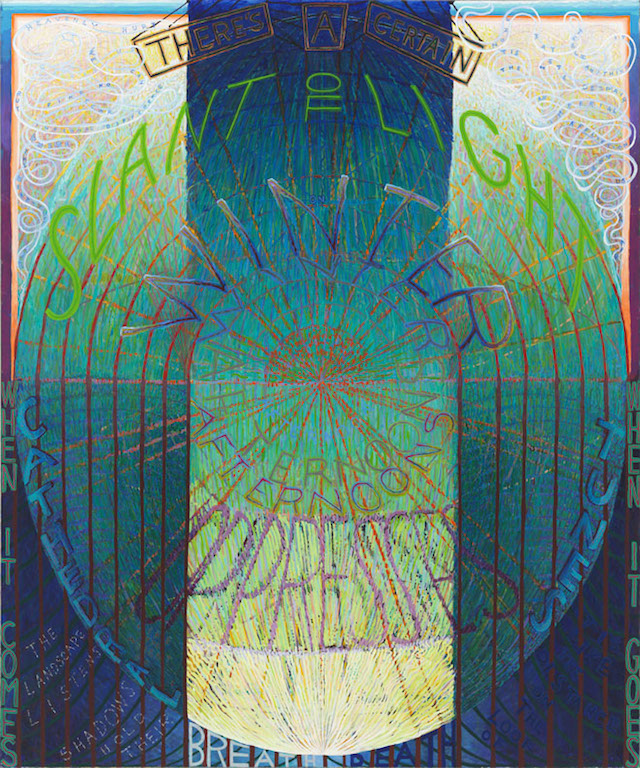
Hansen used unconventional materials (hamburger grease, live worms, matchsticks) to create art to challenge himself. He also wanted to show that art is action, so he created a time-lapse video of his creative process. By using his feet, hand, and mouth, Hansen created artwork which was original and stunning. By inviting people to share their stories of overcoming limitations, he created an interactive art experience.
From Hansen’s experience, I learned that limitation should not be a reason to give up something one is passionate about. This addresses my guiding question: what is the connection of abstract art with learning? By embracing one’s limitation, one can achieve a lot and create something unique and beautiful. This story can inspire students in the classroom and can help them understand that they can achieve anything if they put their minds to it.
Reference
Hansen, P. (2013, February). Embrace the shake. Retrieved June 26, 2019, from https://www.ted.com/talks/phil_hansen_embrace_the_shake?language=en
WILLEM DE KOONING
Willem de Kooning had a love-hate relationship with his mother, who was hysteric and forceful. This experience is often thought to have contributed to the savagery of his woman paintings in the early fifties. His most famous work, a series of paintings called “Woman,” used violent slashing brush strokes that fragmented and distorted women images. These paintings did not have a fixed center of interest, but in the interview, de Kooning describes how he always starts with the mouth as his focal point of reference and then builds the painting around it. The paintings often portray women with large hips and breasts, similar to the portrayal of early sculptures called “Venus” symbolizing fertility. De Kooning used these stereotypical female images instead of models.
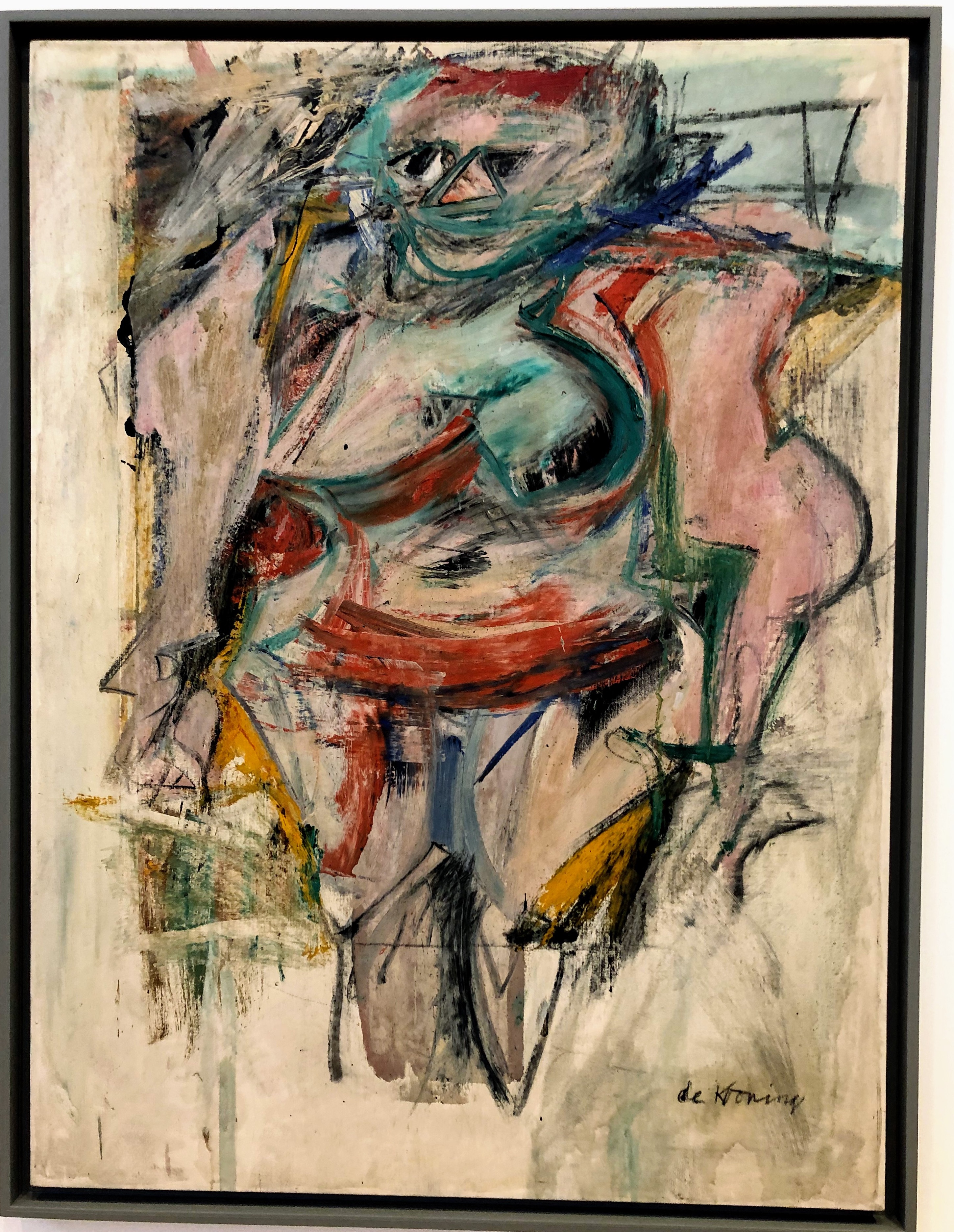
In 1969 he started the “Montauk” series of landscape abstractions. This series had softer colors and appeared calmer, which could be attributed to his move to the countryside, which had a calming influence.
From de Kooning’s experience one can realize that emotions play a big role in abstract art. I find it fascinating that one can infer the dominating influence of emotions during the period in an artist’s life when a specific artwork was created by the style of the brushstrokes, and the use of colors. In his early days when the dominating emotions seem to have been inspired by the relationship with his mother, the elements of abstract art (aggressive brushstrokes, slashing lines, bold colors) are very different compared to the period when he was living in calmer surroundings (softer colors, less aggressive brush strokes). Interestingly, Kooning remarks “The past does not influence me; I influence it.”
This helps me answer the guiding question: what is abstract art? It allows an artist to convey the meaning and emotions through non-representational elements. I learned that emotions convey the mood of the painting, and by letting students create their abstract expression, I can help them with their emotional development.
Reference
Funk, C. (2018). Art, culture, music, film, television. Retrieved July 03, 2019, from https://aaep1600.osu.edu/book/04_deKooning.php
Featured Image: Bhansali, V. Hobbiton. Movie Set. 2019. Photograph. Matamata, New Zealand
 An Art Infused Education