On The Relevance of Abstract Art: A Memoir

(American, 1913–1967)
1963. Oil on canvas, 60 x 60″ (152.4 x 152.4 cm)
Robert Jay Wolff, describes the impact of abstract art in the twentieth century. He argues that this is the only art form that eliminates all implications except what is tangibly there in the painting. He describes the origin of abstract art, which grew in the midst of the Russian revolution, as a symbol of the overthrow of the old social order. The abstract artists in those times felt that their art was an attack on the old order and an integral part of the vital new era.
The author explains his own experience with abstract art, which began in the mid-thirties in Chicago. He describes his conviction that abstract art releases the artist from an art enclosed visual life dictated by history and lets him live as visually unfettered. This new freedom to explore and accept all of life without selecting special aspects of art was exhilarating. He analyses the background of several artists like Reinhardt and Mondrian. They were painters of pure feeling in the abstract tradition. He quotes Mondrian’s correlation of creative intelligence, “which is not simply of the brain, which does not calculate but which feels and thinks” (p. 20).
I learned that Reinhardt’s so-called “black” paintings were painted primarily to satisfy his own aesthetic needs and to confound the gallery goers expectations of instant culture. This article helps me to understand the exhilaration of artistic freedom unfettered by past traditions. It directly addresses my guiding question: what is abstract art?
Reference
Wolff, R. J. (1972). On the relevance of abstract art: A Memoir. Leonardo, 5(1), 19-26. Retrieved from: https//muse.jhu.edu/article/596993/summary
What does the brain tell us about abstract art?
The author Vered Aviv asks an intriguing question in this essay: What does abstract art offer to a human mind that makes it attractive? The author describes various neural experiments to explain how the human brain processes visual cues which trigger localized activities in different brain regions corresponding to different categories of painting: landscape, portrait, still life. Interestingly, we recognize abstract art by exclusion, i.e. by realizing that it does not belong to any other special category.
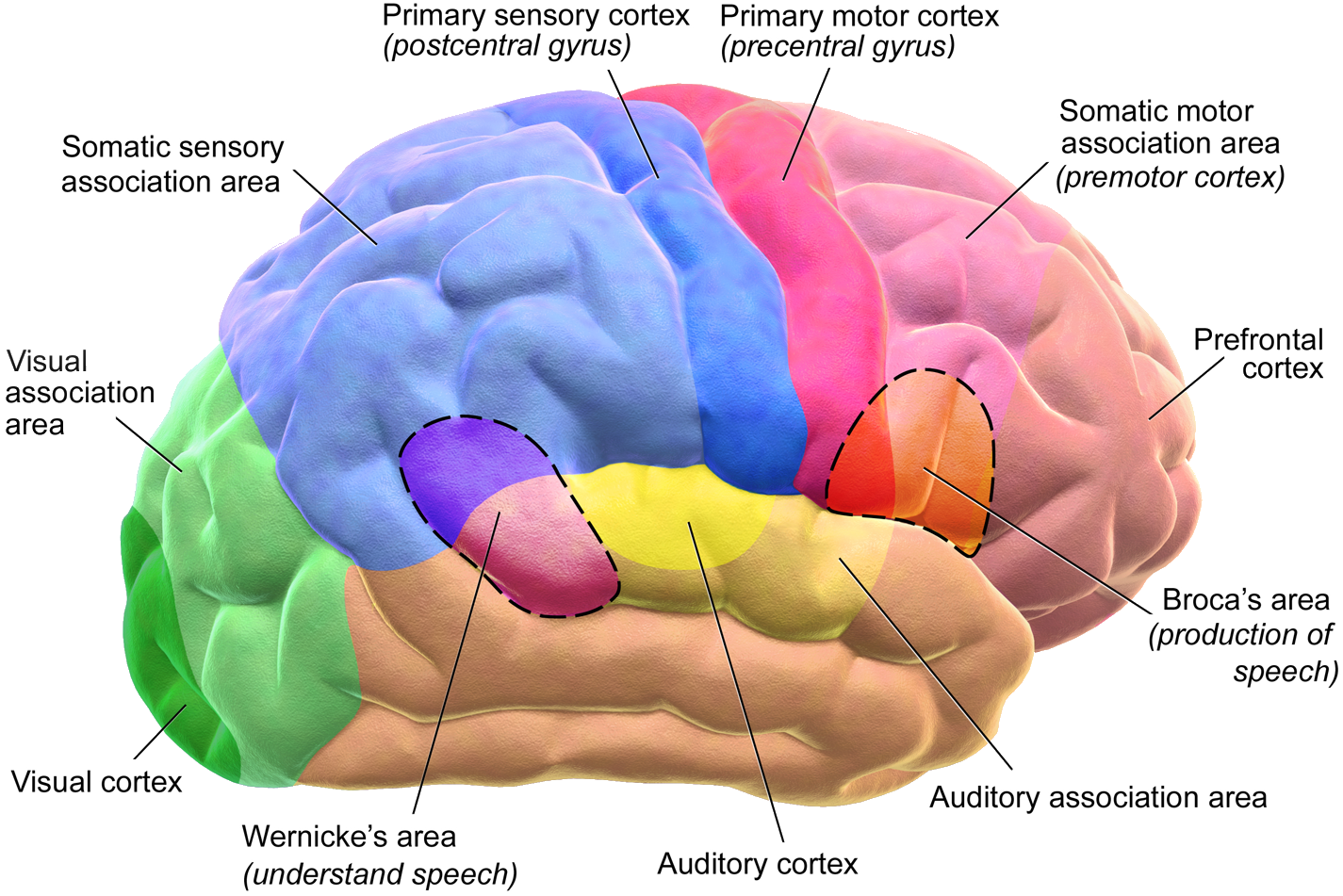
Blausen 0102 Brain Motor&Sensory (flipped).png 12 March 2014
The author “claims that abstract art frees our brain from the dominance of reality, creates new emotional and cognitive associations, and activates brain-states that are otherwise harder to access” (p. 3). This process is apparently rewarding as it enables the exploration of as yet undiscovered inner territories of the viewer’s brain.
This article helped answer my guiding question: what is abstract art? It enabled me to get a deeper understanding of how the human brain functions to appreciate art. It encouraged me to be open to new experiences, both in teaching and in life, that might initially be unfamiliar but eventually could be rewarding.
Reference
Aviv, V. (2014). What does the brain tell us about abstract art?. Frontiers in human neuroscience, 8, 85. https://doi.org/10.3389/fnhum.2014.00085
Interrelationships between mathematics and art for the kindergarten
Evelyn Swartz points out that “in mathematics color is regarded as a property which is used to help children learn to identify and classify shapes and to understand concepts of regions of shapes. In art, however, color may be considered as a concept basic to understanding art, and color theory is an integral part of kindergarten art” (p. 420).
In this article. Swartz compares the relationship between mathematics and art along three dimensions: objectives, content, and teaching procedures. In both fields, the common aim is to develop visual perception skills, to recognize shapes, sizes, and colors. The content of both subjects can be organized logically and sequentially along a semi-concrete continuum. There is also a common relationship between the two fields in the teaching procedures used. The use of multi-sensory aids to enhance the perception of shape, size, and color. Both of them also use problem-solving activities to deepen their understanding.
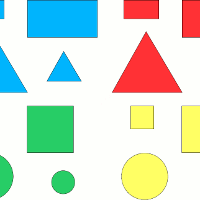
http://www.dr-mikes-math-games-for-kids.com/shapes-sizes-colors.html
The author also shows the differences between the two, e.g., the objective of problem-solving activities and the importance of different concepts, e.g., color in two areas. Teachers who are teaching students should recognize the standard components as well as the differences in both subjects. It will help them to develop strong foundations in both without making one the vehicle of another.
Through this article, I will look for opportunities to reinforce learning in both fields–art and mathematic–through a shared set of content, materials, and teaching procedures. I will also be cognizant of the differences in two fields.
This article clearly answers my guiding question: what is the connection of abstract art with learning? Abstract art assists with the conceptual development and the enhancement of visual perception in this world.
Reference
SWARTZ, E. (1968). Interrelationships between mathematics and art for the kindergarten. The Arithmetic Teacher, 15(5), 420-421.Retrieved from http://www.jstor.org.stmarys-ca.idm.oclc.org/stable/41185799
Preschool and Kindergarten. Every Color on the Canvas: Using Art to Explore Preschoolers’ Understanding of Differences
Exploring the preschoolers understanding of differences in gender and color in art is the authors’ premise in this periodical. The authors are using art to explore preschoolers’ understanding of differences in perception. They also want to delve into the idea that young children move from process-oriented to a product-oriented approach when engaging in art (Fox and Schirrmacher 2015). Additionally, they wanted to analyze the ideas of individuality and originality. “Originality, difference, and variety are to be valued” (Katz & Chard 2000, 155).
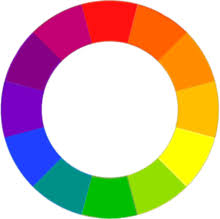
2000 – 2019 Tiger Color
The first thing the authors did was to note the misconception that the children had about appreciating art. E.g., they noted that the children had the wrong impression about colors as being either a boy’s color or a girl’s color. The next aspect the children focused on was the classification of a peer’s image as bad or ugly. The authors’ idea to remove these misconceptions was to invite a female abstract artist to the classroom. The artist explained that abstract art is “when you create something that does not have to look like something in real life” (p. 85). She also talked about how she used all kinds of color in her paintings. Finally, the children watched a video about Jackson Pollock and his use of the color black. The children’s final art reflected their growth in appreciating diversity and subtlety in art forms, e.g. referring to color as being hot or cold and happy or sad.
From this article I learned that inviting an expert to remove misconception was a good idea: by the end, the children felt a sense of pride, and they had accomplished the goal of making a specific type of art. In regards to my guiding question, what is the connection of abstract art with learning, it showed that using one of the elements of abstract art–color–one could help deconstruct the notion of gender as a flexible concept rather than a difference.
Reference
Shedd, M. K., & Coyner, R. L. (2015). Every Color on the Canvas: Using Art to Explore Preschoolers’ Understanding of Differences. YC Young Children, 70(3), 84.
The Use of the Knight’s Tour to Create Abstract Art
Ronald R. Brown describes the use of mathematics as an inspiration for art. History is filled with artists who have used mathematics to produce their art. For example, the “golden ratio”(1) in mathematics was used extensively by Greeks and other artists like Leonardo and Seurat.
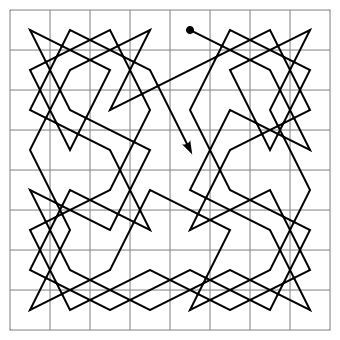
Knight’s tour.svg 19 December 2006
Brown draws his particular idea from the knight’s tour, a well-known chessboard puzzle that has been studied by many mathematicians. Knight’s tour requires coming up with a way to move a knight on a chessboard so that all the 64 squares are visited only once. He was initially intrigued by the patterns made by connecting successive odd positions in the tour. He looked at the results and came up with various ways to represent these solutions artistically. For example, he connected even points to odd points, odd-numbered position to even-numbered positions, used multiples of five, and prime positions. Through these connections, he was able to create artworks, both in two dimensions and three-dimensions that were aesthetically pleasing. Brown concludes that “to him these pieces, which appear to be unrelated, are united by some underlying structure. The disorder that may appear in a piece is an illusion–beneath it all is great order” (p. 58).
This answers my guiding question: what is the connection of abstract art with learning? By introducing chess in the classroom and explaining the knight’s tour, I can generate interest in students in both mathematics and art. Knight’s tour can help students understand how patterns are formed, and this, in turn, can help them come up with their own unique designs. Additionally, by exploring different media–mosaics, tiles, plastic, and metal pipe, etc.–students can learn to create art forms that are based on the same underlying structure.
Reference
Brown, R. R. (1992). The Use of the knight’s tour to create abstract art. Leonardo, 25(1), 55–58. https://doi.org/10.2307/1575622
Notes:
(1) In mathematics, two quantities are in the golden ratio if their ratio is the same as the ratio of their sum to the larger of the two quantities.
Interweaving Art And Geometry
Paul Gerdes is a professor of mathematics at University Belo Horizonte, Boane, Mozambique. He describes his fascination by the art and geometry he saw in basket weaving. His interest in basket weaving started when he bought “65 basket trays that displayed distinctive designs”(p. 25) made by Arlindo Bendzane, a master basket weaver from a village about 70 miles north of Maputo.
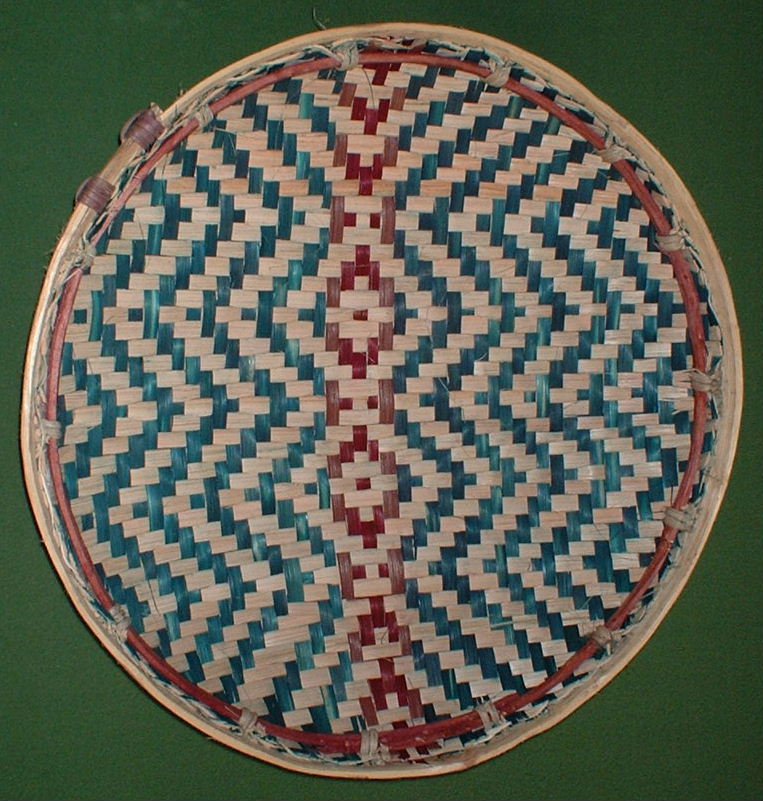
Gerdes, Paulus (2000),
Arlindo has invented and explored a great variety of basket weaving designs. By changing the natural weaving texture through the introduction of lines of discontinuity or by using colored stripe, he has created distinctive designs. For example, in a 2×2 twill, the horizontal strips always go over and under two vertical strips. Interestingly, Arlindo used his knowledge of science to achieve “equal parts” and deliberately broke symmetry sometimes.
Reading this article has reinforced my belief that art is all around us in different forms and shapes and can be found in many human activities. By looking at the art of weaving, I learned that pattern and symmetry could be introduced to students through non-traditional medium. It also answers my guiding question: what is the connection of abstract art with learning?
Reference
Paulus Gerdes. (2012). Interweaving Art and Geometry: Encounter with an African Master Weaver. Math Horizons, 19(4), 25. https://doi.org/10.4169/mathhorizons.19.4.25
CREATIVE EXPERIENCES IN ART
In this journal Ackermann is suggesting how to create aesthetic sensitivity in ourselves and our students. She argues that it has to be done through experience and not by appreciation alone. Too often we read or hear reviews and get affected by that; we seldom use our own visual-tactile experiences and emotional response to line, shape, motion, textures, color, and form.
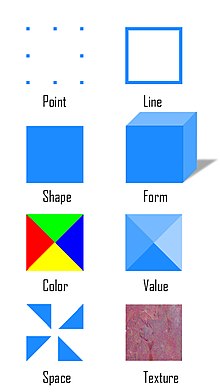
Elements of art.jpgVisual elements 10 November 2018
The author supports her argument by providing examples for various experiences. In the case of line, creative experimentation with art materials in the classroom can enhance the visual and emotional skills around us. With respect to space and motion, she suggests placing oneself mentally at various positions in space; this allows one to become aware of things other than those recorded by a camera. Experience of texture can be achieved with material around us that can foster our physical and visual sense. Color mixing and blending can develop color awareness and sensitivity. Perception of form can be experienced by the use of clay, wood, oil paint, and poster paint. From all these experiences, one can develop a physical-spiritual aspect and critical judgment of things around us. She concludes by saying that “people would develop self-confidence as individuals because their own creative experience would be a real expression of the thoughts, the feelings and emotions, and the dreams of their own time” (p. 231).
From this article, I learned that individual creative experience brings satisfaction, lessens tensions, and reduces monotony. In addition, it helps develop self-confidence, feelings, sensitivity, and dreams. This journal also responds to my guiding question: what is the connection of abstract art with learning?
Reference
ACKERMANN, M. (1950). CREATIVE EXPERIENCES IN ART. Pi Lambda Theta Journal, 28(4), 229-231. Retrieved from http://www.jstor.org/stable/42918410
From Realistic Nature Studies to Geometric Non Figurative Paintings in Which Identical Shapes Appear in Different Colors
Adam Wsiolkowski describes “the development of his approach from realistic nature studies to abstract expressionism to geometric non-figurative paintings” (p.17). From his experience, we can clearly see that having a teacher that permits students to pursue their own interests without exerting pressure helps in discovering one’s latent talent and style.
In his early years, Wsiolkowski painted nudes, landscapes, and still lifes. Gradually, the focus of his paintings shifted from figures to their surroundings. He introduced unreal highlights and shadows to impart simple geometric forms. He would paint the same geometric figures in different colors. He describes his painting technique in great detail, and he credits the long preparatory process and a large number of preliminary sketches for his ability to make precise paintings, whose compositions differ only in color. In future, Wsiolkowski wants to continue his exploration of the radical effects of different color combinations for positive and negative versions of the same picture.
While reading this article I got answers to my guiding question: what is abstract art? It showed me that there is a lot of preparation, thinking and planning of technical details that go into producing art; this is not evident when we see the final picture.
Reference
Wsiolkowski, A. (1981). From Realistic Nature Studies to Geometric Non-figurative Paintings in Which Identical Shapes Appear in Different Colors. Leonardo,14(1), 17-21. doi:10.2307/1574472
Featured Image: Bhansali, V. Taupo Volcanic Zone. 2019. Photograph. Rotorua, New Zealand.
 An Art Infused Education